



A new way to see nerves during surgery
NerveSense uses polarized light to highlight peripheral nerves on the live surgical view, with no dye and nothing touching the patient.
Collaborators & supporters
The problem
1in6
nerve injuries treated at one specialist centre were caused by medical treatment, most often an earlier operation.1
Surgeons protect nerves by knowing the anatomy and by feel. In scarred, irradiated or previously operated tissue, a nerve can look almost exactly like the fat and fascia around it.
Surgeons need to see the nerve, not just confirm it.
Nerve monitoring helps once a nerve is suspected, but it needs a probe on the tissue and tests one point at a time. Fluorescent dyes can make nerves glow, but they need an injection, the right dose and careful timing.
NerveSense takes a different approach. It reads the nerve’s own structure in polarized light, so there is nothing to inject and nothing touching the patient.
How it works
Nerve fibres run in parallel, and that order changes how a nerve reflects polarized light. NerveSense measures the change across the field and marks the nerves on the image the surgeon is already watching.


The system
- 1
Imaging head
White and near-infrared LEDs with polarizing filters, a polarization-sensitive sensor, and a colour camera for the normal view.
- 2
Handpiece
Held like a surgical light, or mounted on an articulating arm.
- 3
Base unit
Processes every frame and sends standard surgical video out over one cable.
- 4
Display
The existing operating room screen. The surgeon keeps the normal view, with nerves marked on top.
A handheld imager, a base unit and the display your team already uses, with the nerve map laid over the normal view.
Procedures
NerveSense is designed for open surgery, wherever an important nerve runs close to the dissection. We are starting with head and neck procedures, where a single nerve controls the voice or the face.

Built with surgeons
Tested in the lab where surgeons train.
What surgeons say
From more than 300 conversations with surgeons across North America.
“IONM is like a parking sensor. It beeps, but doesn’t show you where the obstacle is. NerveSense is like the backup camera showing you the obstacle.”
“This is a see-it, feel-it, believe-it device.”
“There is no specific method per se. It is knowledge of the anatomy. Almost a shame how rudimentary it is.”
Milestones

- 2023
First prototype picks up the polarization signal in tissue
- Aug
NerView Surgical founded in Hamilton, Ontario
- Oct
Second place, The Forge Startup Survivor competition
First place, BioTEC Pitch Competition
- 2025
- Jan
First patent application filed for dynamic polarized light imaging
Ontario Brain Institute NERVE award, $100,000
- Oct
First place, Techtoberfest 2025 Story
- 2026
- Jan
Mitacs Accelerate Entrepreneur funding Story
- Apr
TMC Innovation Healthcare Prize, Rice Business Plan Competition Story
- Apr
$100,000 Ernsting Entrepreneurship Award, FACIT Falcons’ Fortunes Story
- Apr
TiE50 award, TiEcon 2026
- Sep
Selected for Creative Destruction Lab, Toronto
In the news

TMC Innovation Healthcare Prize
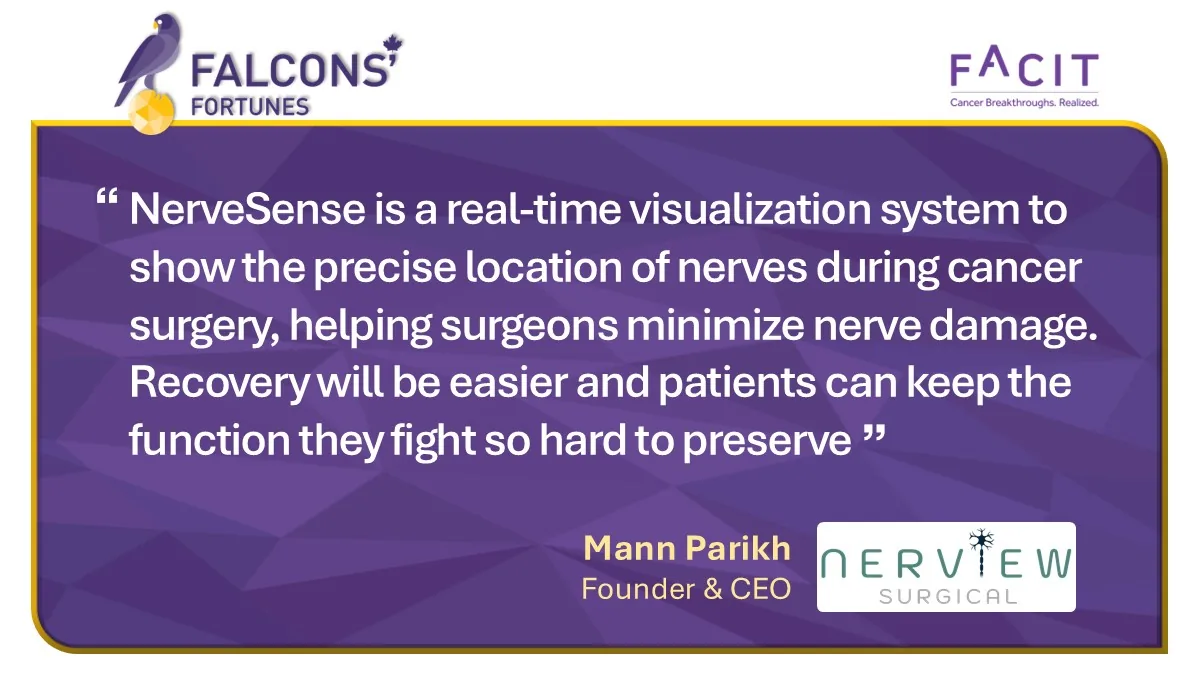
Imaging tech to minimize nerve damage during surgery wins FACIT award
Supported by the Ontario Brain Institute, FACIT, Mitacs, Creative Destruction Lab, The Forge at McMaster University, VentureLab and Communitech.
Talk to us
We work with surgeons, research groups and investors.
c/o The Forge, 175 Longwood Road South, Suite B21Hamilton, Ontario L8P 0A1, Canada